Tuesday, April 17, 2007

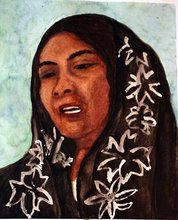
Briefly It Enters, and Briefly Speaks


Quiet Hours. © Graywolf Press. Reprinted with permission.

Briefly It Enters, and Briefly Speaks

I am the blossom pressed in a book,
found again after two hundred years... .

I am the maker, the lover, and the keeper... .

When the young girl who starves
sits down to a table
she will sit beside me... .

I am food on the prisoner's plate... .

I am water rushing to the wellhead,
filling the pitcher until it spills... .

I am the patient gardener
of the dry and weedy garden... .

I am the stone step,
the latch, and the working hinge... .

I am the heart contracted by joy... .
the longest hair, white
before the rest... .
I am there in the basket of fruit
presented to the widow... .

I am the musk rose opening
unattended, the fern on the boggy summit... .

I am the one whose love
overcomes you, already with you
when you think to call my name... .

Tuesday, April 10, 2007

How They Voted on UNCSW


Economic and Social Council
WOM/1622
Department of Public Information • News and Media Division • New York
Commission on the Status of Women
Fifty-first Session
13th Meeting* (PM)

AS SESSION ENDS, COMMISSION ON STATUS OF WOMEN APPROVES TEXTS ON PALESTINIAN

WOMEN, PROTECTION FROM HIV/AIDS, FEMALE GENITAL MUTILATION, FORCED MARRIAGE

Members Adopt Provisional Agenda; Elect Chair, Other Officials of Bureau


Background

The Commission on the Status of Women met this afternoon to take action on several draft resolutions and adopt its agreed conclusions.

/...

Action on Draft Resolutions

/...

The Chairperson then turned the Commission's attention to the draft resolution on the situation of and assistance to Palestinian women (document E/CN.6/2007/L.2), saying it also contained no budget implications.

The representative of Pakistan made oral amendments to the text, after which the Chairperson said a recorded vote had been requested.

Asked by the representative of Pakistan who had asked for the vote, the Chairperson said the United States delegate had requested it.

The representative of Israel, making a general statement, said that, as in previous years, the Commission had before it a politically motivated text. Since it did not address the Palestinians' internal human rights abuses and continued terror -- which caused suffering to both Palestinian and Israeli women -- the draft left much to be desired.

Human Rights Watch had reported abuse of women, such as honour killings, she said, adding that other instances of human rights abuses had been reported to the Commission by the Secretary-General and others. The deliberate exclusion of those instances distorted the draft resolution. Indeed, it was in the interest of all parties to improve Palestinian women's quality of life, but the current Palestinian leadership had not fulfilled it obligations, as stipulated by the Quartet. If Hamas did not embrace its responsibility to end terror, women on both sides would continue to suffer. The draft resolution was another reminder of the "stark contrast between reality and rhetoric on First Avenue".

The Commission then approved the text by a recorded vote of 40 in favour to 2 against ( Canada, United States), with no abstentions. (See Annex.)

The representative of the United States, speaking in explanation of vote, said her country remained deeply concerned about the impact of the current crisis on Palestinian women and the entire Palestinian population. The United States was the largest bilateral donor to the United Nations Relief and Works Agency for Palestine Refugees in the Near East (UNRWA), and contributed significant amounts to other programmes of the Organization, besides bilateral assistance to needy Palestinians. However, it grieved for innocent Israelis, including Israeli women, who had suffered and died due to Palestinian terror attacks -- a reality that many did not recognize. The international focus should be on helping both parties to maintain progress. One-sided resolutions undermined the ability of the United Nations to play a constructive role in furthering peace, which would improve the lot of Palestinian women more than anything else.

The representative of Germany, speaking on behalf of the European Union, said the text was of a primarily humanitarian nature. The European Union remained the largest contributor of assistance to the Palestinian people and had voted in favour of the text. Deeply concerned about the impact of the conflict on all women in the region, including both Palestinian and Israeli women, the European Union underscored the need for an approach that took into consideration the impact of the conflict on all sides. The role of women in the peace process was worthy of further investment, and the European Union invited the delegation of the Palestinian Permanent Observer Mission to engage in a dialogue on how best to address the issue at the United Nations. The European Union's vote today was without prejudice to future positions it might take in the Commission and other fora.

The representative of Canada said his country was committed to alleviating poverty and addressing socio-economic inequities throughout the world, including those affecting Palestinian women. However, Canada was concerned about operative paragraph 4 of the text, which called on Israel to facilitate the return of refugees and displaced Palestinian women and children to their homes. It seemed to prejudge negotiations on key issues arising from the Palestinian-Israeli conflict, which could only be addressed through a settlement on final status issues.

The observer for Palestine thanked those who had voted in favour of the draft resolution, especially the "Group of 77" developing countries and China. The text sent a strong message of solidarity with the women of Palestine. Though some said it was one-sided, it was not the text, but rather the situation as a whole, that was unbalanced. The occupying Power had continued to carry out illegal measures with complete impunity for 40 years, causing misery to Palestinians, whom it held hostage. The statement by its representative seemed to have distorted the issue at hand. Israel should take care to examine its own domestic situation by looking at abuses occurring at the highest levels of its own Government. The only way to guarantee the rights of Palestinian women was for Israel to end its occupation.

/...

The representative of Zambia requested the floor regarding the draft resolution on Palestinian women, saying she would have voted in favour of the text had her delegation been in the room.

The representative of Lesotho said she also would have voted in favour had she been present.

/...


ANNEX

Vote on Palestinian Women

The draft resolution on the situation of and assistance to Palestinian women (document E/CN.6/2007/L.2) was approved by a recorded vote of 40 in favour to 2 against, as follows:

In favour: Algeria, Armenia, Belgium, Belize, Bolivia, Brazil, China, Congo, Croatia, Djibouti, Dominican Republic, Ecuador, El Salvador, Germany, Ghana, Hungary, Iceland, India, Indonesia, Iran, Japan, Kazakhstan, Malaysia, Mali, Mauritius, Mexico, Morocco, Netherlands, Nigeria, Peru, Qatar, Republic of Korea, Russian Federation, Suriname, Thailand, Togo, Turkey, United Arab Emirates, United Kingdom, United Republic of Tanzania.

Against: Canada, United States.

Absent: Cameroon, Lesotho, Zambia.

* *** *

__________

* The 12th Meeting was closed.

For information media • not an official record

Friday, April 6, 2007

Leaving

The Reverend James V. Stockton is Rector of The Episcopal Church of the Resurrection in Austin (Diocese of Texas). He posted these reflections on the House of Bishops/Deputies listserv, and has given permission for us to publish his thoughts on The Episcopal Majority site.

This piece comes to us from the Reverend Thomas Woodward along with this note:

I find Jim Stockton's article both comforting and challenging -- and believe it will be so for the whole of The Episcopal Church. We are publishing it at The Episcopal Majority both for its intrinsic value and for what it evokes and provokes. We hope you will engage us and one another with your comments.


Leaving
(The Rev. James V. Stockton)

Bishop Cox is 'leaving' for the Southern Cone; Bishop Herzog is leaving for Roman catholicism; the Church in England is leaving Rome to become the Church of England; and the Church of England in the American Colonies is leaving to form the Episcopal Church in the United States of America. The difference between the latter two instances and the two former is that the first two are current and the latter are now history. But they all serve to demonstrate that division per se is not an evil in and of itself. To suppose that the devil is enjoying all this is to presume that the devil is paying attention to any of this and doesn't have more important things to do. I think it's time for a reality check. Division doesn't equal decay. Division is the natural and God-given process that enables growth. So I pray we can all relax the lamentations a bit and bring our reactions into a healthier perspective. Let's make sure not to confuse religion with denomination, faith with Church. Our religion is Christianity, our faith is Christian. Our denomination is the Episcopal Church, and our Church is a part of the One, Holy, Catholic, and Apostolic ideal. When people depart the Episcopal Church, they aren't, unless specifically stipulated, departing Christ or Christianity.

So, where people choose to follow their consciences rather than compromise them, I see God at work in this, not the devil. Where there are available a multiplicity of branches extending from the one tree of the Christian faith, I see God at work in this, not the devil. Where the entirety of Christianity is indeed almost able to be all things in order to reach all people, I see God at work in this, not the devil.

Conversely, where I see a single branch trying to function as the whole tree, I see human pride at work in this. Where I see people unable or unwilling to celebrate one another's progress in relationship with God because that progress draws them out of conformity with one another, I see human pride at work in this. When I see people unable or unwilling to renew and adapt their relationships with one another as they follow their respective paths, I see human pride at work in this.

What is it, after all, that is 'dividing' people? People aren't leaving Christ Jesus; they aren't leaving the Communion of Saints. They are leaving nothing greater than the former structures of relationship; that's all. It is differences around ecclesiology that are causing some people to divide from one another. And this is not automatically a bad or evil thing. Some people simply cannot or will not abide a Church that admits and allows a plurality of theological views on matters beyond the Creeds. Matters of hermeneutics, authority and power, social conformity, all come under the umbrella of definitions of 'Church;' and these are the matters around which some are deciding to leave.

Bp Cox, former Bp Herzog, Martyn Minns, David Anderson, and others are following their hearts and minds to Christian relationships that do not as deeply include some of the rest of us as did our former official relationships. Our own convictions are moving us to remain. Our staying put and their departures are outward and visible signs of an inward and invisible reality. If the adjustments in our relationships help keep us all more honest, then so much the better for all of us. And we will do well then to remember that ecumenism is a fine old tradition of our Church. Wherever there are good, decent, faithful people upon whom we wish to call for the service of our own progress in faith, then thanks be to God, there are simple honorable ways for us to invite one another to share our gifts.

I would encourage us to rejoice that people who choose not to remain under the particular banner of the Episcopal Church are in fact free to exercise their consciences, and that they have available to them fellowships of Christian faith that are better suited to them to which they can go. The real tragedy would be for people to compromise their deeply held convictions in order simply to stay superficially and under duress. What is actually lamentable in some of this is the insistence by some that those from whom they are departing are no longer real and genuine Christians. This sort of Christian-on-Christian sin truly is indeed lamentable. For, while you and I may disagree about the relative gravity of concerns that move people to leave, there is no inherent tragedy in the departure itself. If people are following their consciences, being the best Christian they know how to be, then thanks be to God, and let's stay in touch. All that's happening is some people are "changing their addresses"; they're not dying, for goodness sake. If we're really important to one another, then we'll allow all of this to function only as distinction, not as division. We won't allow it to come between us, but only to draw us closer in the work and faith we share.

Tuesday, April 3, 2007

Mortality in Afghanistan


Mojadidi Opens Her Lens to Afghan Motherland

By Sharon Johnson - WeNews correspondent

(WOMENSENEWS)--Sedika Mojadidi, an Afghan American filmmaker, watched in horror as an expectant mother gasped for breath in the maternity ward of Rabia Balkhi Hospital in Kabul, Afghanistan, in August 2003.

The 15-year-old woman and her husband had traveled on horseback for three days because they wanted their first child to be born in the largest women's hospital in the war-torn country. But preeclampsia--dangerously high blood pressure during pregnancy--and the lack of prenatal care in their mountain village had taken their toll: mother and infant died despite the heroic efforts of the obstetrics team.

Despairing scenes like this are common in Afghanistan where 16 percent of women die while pregnant or during childbirth, one every 30 minutes. Afghanistan today has the second highest maternal mortality rate in the world, behind only Sierra Leone, according to the United Nations. In some areas of Afghanistan, maternal rates are as high as 6,000 per 100,000 women.

Afghans' hopes were high that maternal health would improve in the country in October 2001 when the U.S.-led invasion toppled the hard-line Taliban regime. Hundreds of reporters poured into Afghanistan to describe the establishment of a new government and plans to build hospitals and schools. But by 2003, most journalists had departed for Iraq, when Mojadidi and her father returned to their native Kabul from Jacksonville, Fla., where the family had immigrated in 1973.

Dr. Qudrat Mojadidi, an obstetrician specializing in high-risk pregnancies, had been recruited by the U.S. government to help rehabilitate Rabia Balkhi Hospital, including a unit that was renamed as the Laura Bush Maternity Ward. Sedika Mojadidi had come along to make "Motherland Afghanistan," a behind-the-scenes documentary that looked at the crippled health care system and its impact on women.

Elizabeth H. Williams, acting director of the Asia Society's Asian Social Issues Program, said the film, coupled with data and other public health efforts, might spur changes in public policy and generate funding by highlighting a rare issue in today's media coverage of war and reconstruction.

"To do a feature-length film on maternal mortality is really important, because there are not a lot of people out there doing that," she said. "It's one of the key issues."

Concentrated on Systemic Neglect

Unlike other reporters who have focused on the continuing U.S. military presence and the hunt for terrorists in Afghanistan, Mojadidi concentrated on how the systematic neglect of basic services such as prenatal care is undermining U.S. efforts to win hearts and minds.

"I hope the film will give American audiences a more realistic view of Afghan women," said Mojadidi in an interview before a sold-out February screening at the Asia Society in New York. "For the past 25 years, Afghan women have either been ignored in news reports of the Russian occupation and the subsequent civil war, or portrayed in TV films as victims. However, the women in my documentaries don't consider themselves victims; they do everything possible to keep themselves and their children alive."

To film Afghan women living under the brutal Taliban for her first film, "Kabul, Kabul," in 1996, she hid a tiny camera under her veil and traveled in a hospital van to avoid being stopped by police.

For "Motherland Afghanistan," her second film, Mojadidi tapped her experience as a field producer and cameraperson on several medical shows on the Learning Channel. Coming up with a script was difficult because so many factors influence maternal mortality, she said.

High Death Rate for Women

Most Afghans are desperately poor; the United Nations Development Program estimates that 70 percent of the population lives below the poverty line of $2 a day. Although the legal marriage age is 18, 57 percent of girls marry before 16. Few women deliver in a medical facility because there are only 1,100 clinics and 100 hospitals serving 30 million Afghans. As a result, half of all deaths among women of reproductive age are the result of pregnancy and childbirth.

"I decided that the best way to personalize the crisis was to make my father the central character because he has devoted his life to delivering babies and training doctors in Afghanistan," Mojadidi said. "In 2002, he was nominated for a Nobel Peace Prize for his 20 years of work with Afghan refugee women."

The Laura Bush Maternity Ward was not what the Mojadidis had expected.

"Although the U.S. Department of Health and Human Services had touted the hospital as a state-of-the-art facility on its Web site and press releases, it was a disaster," she said. "Infection control was nonexistent; patients delivered on the same plastic sheets one after another. Patients had to buy medications for their surgeries from a pharmacy near the hospital because promised supplies never arrived."

U.S. officials discouraged her from filming the delivery rooms and interviewing the overworked staff.

Struggle to Improve Maternal Care

Her father, Dr. Mojadidi, realized that he couldn't do enough to improve health care at the hospital and resigned after several months. Two years later, an Afghan-led nongovernmental organization that manages hospitals, schools and shelters in Central Afghanistan persuaded him to come back to work at Shuhada Hospital, a rural facility that emphasizes prevention and education. Sedika spent two months there finishing "Motherland Afghanistan."

"Every day my father resisted being on camera but relented because he and the staffs of the hospitals agreed that showing him treating patients in such deplorable conditions was the best way to get the truth out about the maternal mortality crisis," said Mojadidi. "Making the film gave me new insights into the challenges he has faced in his profession and brought us closer. However, making a film together is not an experience that either of us wants to repeat; it is too stressful."

The film's final scenes are profiles in perseverance and hope. After delivering a premature baby, Dr. Mojadidi shows the staff how to treat the infant's respiratory problem. He also instructs the team in the latest methods of treating obstetric fistula and the resulting urinary incontinence following childbirth. As a result, they successfully complete a complicated surgery and, despite the odds, are able to cure a young mother who had been unable to leave her home for four years.

Since "Motherland Afghanistan" was completed, Dr. Mojadidi has trained the first five doctors in an obstetric-gynecological fellowship program for CURE International Hospital in Kabul.

Mojadidi is also working on a new film project that focuses on another common experience of Afghan women: arranged marriages.

"Many people in the independent film business have warned me that a film about a young Afghan woman who comes to the U.S. and meets her husband for the first time will never attract audiences because Americans are only interested in films about the war in Iraq these days," said Mojadidi. "But I'm going ahead because I think that everybody can identify with a resilient Afghan woman who creates a new life in America."

--Alison Bowen contributed to this story.

Sharon Johnson is a New York freelance writer.

Tuesday, March 27, 2007

Taking Action for Guatemalan Women!


Dear Friends,

For 36 years, Guatemala suffered through an internal armed conflict in which at least 200,000 people were "disappeared" or killed. State-sponsored violence was widespread, entire villages were burned and razed, and rape was commonly used as a weapon of war against women. Numerous investigations have concluded that the vast majority of these human rights violations were conducted by members of the Guatemalan Army or intelligence services.

Today, a decade after the conflict's resolution, many of those responsible have escaped prosecution and now work with the police or private security forces. Perhaps it is no wonder that violence against women continues unabated, and that the perpetrators are virtually never brought to justice.

Human rights groups have documented a sharp increase in the rate of "femicides" or killings of women in Guatemala since the beginning of 2000. As of August 2006, 2,300 Guatemalan women had been murdered, and only 17 cases had been resolved, including both convictions and exonerations. In fact, so few convictions have been handed down that there is almost complete impunity for those who murder women in Guatemala. Investigators mishandle crime scenes and officials blame the victims themselves, often deciding that their murders are not worth investigating because they are deemed to be "nobodies."

The Women's Edge Coalition and the Center for Gender & Refugee Studies have joined together to condemn the institutional acceptance of violence against women in Guatemala. In November 2006, members of the U.S. House of Representatives introduced a resolution calling on the Secretary of State to urge the Government of Guatemala to improve its procedures for investigating and prosecuting crimes of violence against women. Representative Hilda Solis of California re-introduced the resolution (H. Res. 100) in January 2007, and a vote is expected in the House very soon. (A similar resolution is currently being considered in the Senate.)

Join us in asking your representative in Congress to sign on as a co-sponsor of H. Res. 100. To identify and contact your Congressperson in the U.S. House of Representatives, click here; to check and see if your representative is already a co-sponsor of H.Res. 100, click here. If he or she has not yet signed on, you will find a sample message that you can personalize and send below.

The war in Guatemala is long over. It's time for Guatemalan women to enjoy the benefits of peace.

In Solidarity,

Karen Musalo
Director
Center for Gender & Refugee Studies

Barb Gottlieb
Director of Outreach & Membership
Women's Edge Coalition


[SAMPLE MESSAGE]

Dear Representative [name],

During Guatemala's decades of internal armed conflict, state-sponsored violence was widespread, and rape was commonly used as a weapon of war against women. Numerous investigations have concluded that the vast majority of these human rights violations were conducted by members of the Guatemalan Army or intelligence services.

Today, a decade after the conflict's resolution, many of those responsible have escaped prosecution and now work with the police or private security forces. Perhaps it is no wonder that violence against women continues unabated, and that the perpetrators are virtually never brought to justice.

Human rights groups have documented a sharp increase in the rate of "femicides" or killings of women in Guatemala since 2000. As of August 2006, 2,300 Guatemalan women had been murdered, and only 17 cases have been resolved, including both convictions and exonerations. In fact, so few convictions have been handed down that there is almost complete impunity for those who murder women in Guatemala. Investigators mishandle crime scenes and officials blame the victims themselves, often deciding that their murders are not worth investigating because they are deemed to be "nobodies."

I urge you to join your colleagues in Congress in condemning the institutional acceptance of violence against women in Guatemala by signing-on as a co-sponsor of H. Res. 100, which encourages the Guatemalan government to bring an end to these crimes. To co-sponsor H. Res. 100, contact Representative Hilda Solis's office at (202) 225-5464.

The war in Guatemala is long over. It's time for Guatemalan women to enjoy the benefits of peace.

Sincerely,

[name & address]

Sunday, March 25, 2007

News from South Africa


Greetings from Boksburg, South Africa

After eight days of hard work the TEAM Conference - Toward Effective
Anglican Mission: Prophetic witness, social development and HIV and AIDS -
came to an end on 14 March. More than 400 people from 32 of the 38
provinces of the Anglican Communion, gathered together in Boksburg, South
Africa, to discuss our call to God's mission in the world of today. This
conference has energized all of us, as a Communion, to seriously contribute
to the achievement of the MDGs and, more importantly, to do so in the
context of God's mission.

We began each day with eucharist - led by a different region each day, with
great variety in style and song - then Bible study, in the same small
groups, after breakfast. These discussions, focusing on the Bible and the
day's theme, provided our foundation for the day. We heard excellent
presentations and panels, beginning with Archbishop Ngongonkulu Ndungane of
Cape Town, and the Archbishop of Canterbury, Dr Rowan Williams, who
grounded our deliberations in the theology of mission. Plenary sessions
were followed by a group of workshops to choose from. Conversations around
meals gave an opportunity to talk to some of the many people we met in more
detail. The days were long, full, and inspiring.

Sunday fell, happily, in the middle of the conference, providing a welcomed
change of pace. We were invited to attend one of about a dozen churches
around the Johannesburg area. Wherever we went, we were uplifted by their
warm hospitality and the varied expressions of faith lived out in their
worship. The church in Daveyton had much wonderful singing, in four
languages simultaneously and alternating quite naturally between hymns most
of us would recognize from Hymns Ancient and Modern and hymns from their
own musical traditions. The sermon was made even more interesting by the
synchronized interpretation and, before the rector blessed the children as
they went to Sunday school, he told the congregation that they were
struggling with the passage: "and forgive us our trespasses as we forgive
those who trespass against us", asking for their prayers, that the Holy
Spirit be with them.

There is very good news and audio coverage on the Episcopal News Service
at: http://www.episcopalchurch.org/3577_23466_ENG_HTM.htm so rather than
giving you more details on the conference here, we urge you to read the
articles and listen to the audios. For some of the presentations, the full
text is available through the news story. We especially recommend the
coverage of the opening eucharist; Archbishop Ndungane's opening address;
Archbishop William's presentation: Knowing the Lord; speakers set MDGs in
theological context, which includes Hellen Wangusa (excellent); but they
are all well worth reading. The keynote address of the Archbishop of
Canterbury is on his website at:
http://www.archbishopofcanterbury.org/sermons_speeches/070313.htm

If you read nothing else, the must read is Archbishop Ndungane's concluding
remarks, which amount to the executive summary of the conference and its
conclusions and call to action, at:
http://www.episcopalchurch.org/3577_83593_ENG_HTM.htm (If you are unable
to access this, let Helena know, and she will send it to you in the body of
an e-mail.)

Other information, including the programme, can be found on the TEAM
website at: http://www.team2007.org/index.htm

There is much from this conference that we, as women, will want to advocate
and pursue. More to follow as we review the summary and reports. Suffice it
to say now that it was a superb and inspiring conference, examining what
God demands of us in caring for the poor and suffering and all of His
creation in the world of today.

Networking and links

There was excellent opportunity for networking and we were able to speak to
many, both men and women, lay, clergy and bishops - even archbishops -
about IAWN, the gathering in New York and our statement, giving out the
brochure, statement and resolution ACC13-31. Jenny Te Paa included the
statement in her presentation on the second day and it was very well
received and sparked a lot of interest. We had a surprise parallel event on
the UNCSW experience where several talked about how they brought it home
and the experience in New York.

A number of parallel events were led by other delegates who have been at
the UNCSW/IAWN sessions, including Lisbeth Barahona (Parallel event) on
Gender, Trade and Entrepreneurship; Claudette Kigeme (Seminar) on Investing
in Human Security to Prevent Conflict and Promote Peace Building; Hellen
Wangusa (Workshop) on Education as a Basic Human Right; and Martha Gardner
(Seminar) on Climate Change. Mugisa Isingoma, from the Anglican Church of
the Congo, was to lead a fully signed-up seminar on Bottom-Up Solutions:
Grassroots Women Participate in Post-Conflict Reconstruction, but was
unable to attend due to visa problems.

We invited all the women we talked with to join the IAWN network, and hope
many of them will respond.

Meeting of ACC network representatives

Kenneth Kearon called a meeting on Saturday, March 10, of all the
representatives of ACC networks. We found this very instructive and
helpful. In the course of this discussion we realized that in fact IAWN is
doing quite well. The discussion centred on how each network was doing, its
structure and succession. All of us have problems of communication and
funding. Most of the others meet very rarely, while others have big
meetings every 3-5 years. Some are more active than others. Kenneth said
JSC is very supportive of the work of the networks. All networks are
expected to submit yearly reports to the JSC as well as a triennial report
to the ACC.

The Anglican Communion website is being redone. All networks will have a
link on the site and the IAWN Steering Group will be updating our website
over the coming months. (More on this as it develops.)

Conversation with Hellen Wangusa

We had a delightful and informative conversation with Hellen one evening.
She very much regretted not being in New York for the UNCSW but visa
problems (still unresolved) and other matters made it impossible. Hellen
has an amazing grasp of both the UN and the ACC, and a real sense of what
she wants to do. She strongly believes that we should always keep what we
do in a theological context, and not be just another NGO, but a strong FBO
(faith-based organization). We feel it will be a joy to work with her.

Our comments and reflections

Discussing all this with Lisbeth Barahona one evening, we agreed that there
are exciting possibilities ahead. And that our work has more direction and
clarity after being here.

The Anglican Communion rarely has meetings that bring so many together from
across the Communion. As those of us who have been in New York for the
UNCSW know, there is great and wonderful diversity in our Communion, and a
deep commitment to the mission of our church. The same was true in
Boksburg. It was a wonderful opportunity to get to know others, share
concerns and joys, and build and strengthen relationships across the
Communion - a significant outcome in itself. Everyone there was deeply
committed to furthering together the work of Christ in the world.

In mission,

Esperanza Beleo and Helena Mbele-Mbong

IAWN representatives at the TEAM Conference

BBC E-mail: Slave Children with Rageh Omaar

Alyssa saw this story on the BBC News website and thought you
should see it.

** Message **
Here is a great report on modern-day slavery around the world. Listen to it tomorrow night on BBC.

** Slave Children with Rageh Omaar **
Around 8.4 million children are enslaved today. Now, five of them tell their stories.
< http://news.bbc.co.uk/go/em/fr/-/2/hi/programmes/this_world/6446051.stm >


** BBC Daily E-mail **
Choose the news and sport headlines you want - when you want them, all
in one daily e-mail
< http://www.bbc.co.uk/email >


** Disclaimer **
The BBC is not responsible for the content of this e-mail, and anything written in this e-mail does not necessarily reflect the BBC's views or opinions. Please note that neither the e-mail address nor name of the sender have been verified.

If you do not wish to receive such e-mails in the future or want to know more about the BBC's Email a Friend service, please read our frequently asked questions. http://news.bbc.co.uk/1/hi/help/4162471.stm